
Description
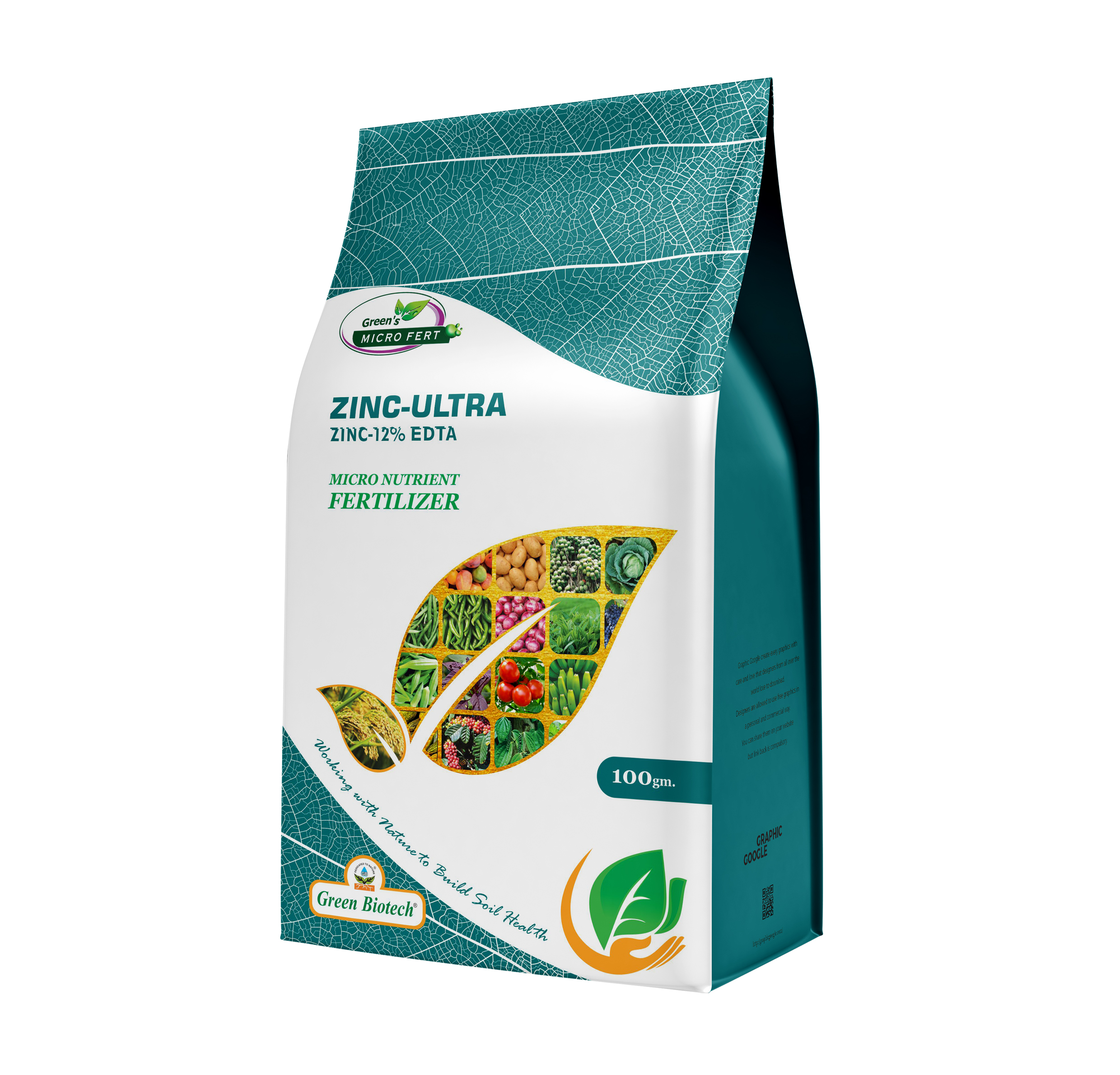
ZINC-ULTRA (Zn EDTA 12%) is a highly efficient way to deliver the essential micronutrient zinc to plants.1
Key Information About ZINC-ULTRA
| Component | Detail |
| Active Ingredient | Zn EDTA (Chelated Zinc) |
| Concentration | 12% Zinc |
| Formulation Type | Water-soluble micronutrient fertilizer |
| Primary Goal | Correction and prevention of zinc deficiencies |
Role and Benefits of Chelated Zinc (Zn EDTA)
The primary advantage of the chelated (EDTA-bound) form is its enhanced bioavailability compared to non-chelated forms (like Zinc Sulfate Heptahydrate).2
| Role/Benefit | Description |
| Enhanced Availability | Being in a chelated form prevents zinc fixation in the soil, ensuring the nutrient remains soluble and completely available for plant uptake, even in alkaline or high pH soils where non-chelated zinc often becomes unavailable. |
| Enzyme Activation | Activates oxidizing enzymes, which are crucial for plant metabolism and energy processes. |
| Hormone Synthesis | Essential for the synthesis of important growth hormones (auxins), which promote cell elongation and overall plant development. |
| Photosynthesis & Chlorophyll | Plays a major role in chlorophyll formation and photosynthesis, leading to healthier, greener plants. |
| Increased Yield | Quickly corrects zinc deficiencies, which typically result in stunted growth, prolonged crop duration, and poor yields. |
| Versatility | Can be used on all types of crops and soils, and is suitable for various application methods like foliar spray and drip irrigation. |
| Systemic Nature | Chelated zinc is often considered to be partially systemic, meaning it can be easily translocated (moved) within the plant after absorption. |
Dosage and Application
- Standard Dosage (Foliar Spray): 1 gram per Liter of water ($1 \text{ gm/Liter}$).
- Common Application Method: Foliar spray (spraying directly onto the leaves).3
- Other Methods (Typical for Zn EDTA 12%): It can also be applied via Drip/Fertigation (mixing with irrigation water) and sometimes mixed with soil.4
- Note: For large-scale application, a typical foliar spray rate is around 5$100 \text{ g}$ to 6$200 \text{ g}$ per acre, mixed in 7$150 \text{ L}$ to 8$200 \text{ L}$ of water.9
- Note: For large-scale application, a typical foliar spray rate is around 5$100 \text{ g}$ to 6$200 \text{ g}$ per acre, mixed in 7$150 \text{ L}$ to 8$200 \text{ L}$ of water.9
Difference from ZINC-HIGH (Zinc Heptahydrate)
| Feature | ZINC-ULTRA (Zn EDTA 12%) | ZINC-HIGH (Zn Heptahydrate 21%) |
| Form | Chelated (Zinc bound to EDTA) | Inorganic (Zinc Sulfate) |
| Zinc Content | Lower (~12%) | Higher (~21%) |
| Bioavailability | Superior; protected by the chelate, making it readily available for the plant, especially in high pH or alkaline soils. | Good (highly water-soluble), but the zinc ion ($\text{Zn}^{2+}$) can easily become fixed or “locked up” in alkaline soil, reducing effectiveness. |
| Best Use | Foliar spray and drip irrigation where instant, highly efficient uptake is required, or in problem soils. | Soil application (due to high zinc content) and foliar spray. |
Reviews
There are no reviews yet.