

Description
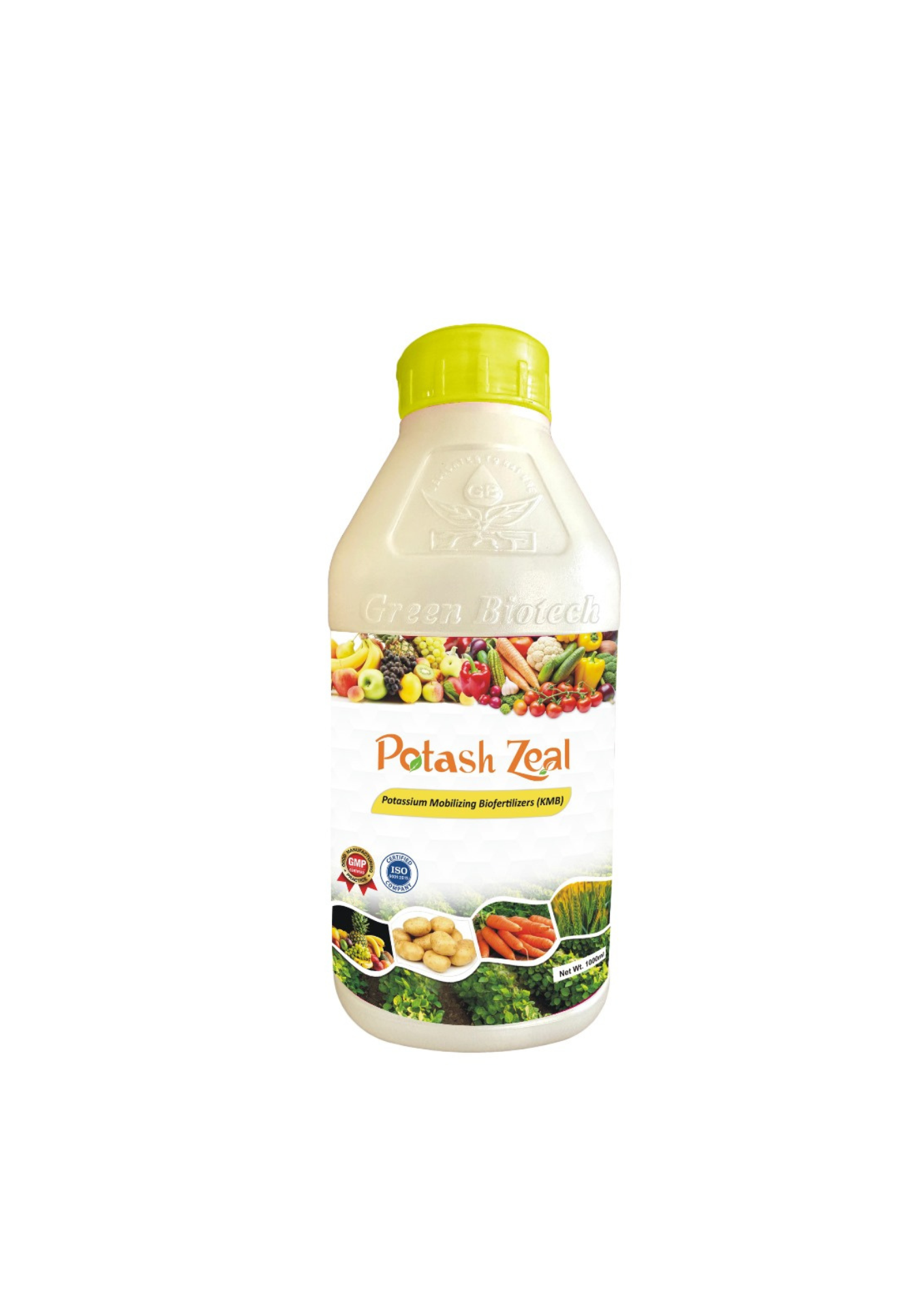
POTASH-ZEAL
This is an eco-friendly formulation designed to leverage natural microbial activity to improve soil fertility and plant health.
Key Component & Mechanism
- Active Ingredient: The beneficial bacterium Frateuria aurantia.
- Role: This bacterium is a well-known Potassium Solubilizing/Mobilizing Bacteria (KMB).
- Mechanism:
- The bacteria colonize the rhizosphere (the soil area immediately surrounding the plant roots).
- They secrete organic acids and enzymes that break down the large, insoluble forms of potassium (K, which makes up about 90-98% of K in soil) that plants cannot use.
- This process converts the fixed potassium into a soluble, readily available form ($K^+$) for the crop to absorb.
Primary Functions & Benefits
| Benefit Category | Specific Effect | Description |
| Nutrient Management | Potassium Mobilization | The core function: it unlocks the existing, but unavailable, potassium reserves in the soil, ensuring the plant receives a steady supply. |
| Plant Health & Resistance | Disease & Stress Resistance | Potassium enhances the plant’s natural ability to withstand stress from diseases, pests, cold, and other adverse conditions (biotic and abiotic stress). |
| Growth & Yield | Substantial Growth | Helps crops grow at a faster rate and improves overall crop growth and yield (Studies suggest KMB can increase yields by 10-30%). |
| Economic & Eco-Friendly | Cost Reduction | The product claims to reduce the cost of potash application by 50-60% because it maximizes the use of natural soil K, reducing the need for chemical fertilizers. |
| Adaptability | High Tolerance | It tolerates a wide range of soil pH and temperature, making it effective in diverse farming environments. |
Application Details
- Dosage (Liquid): 500 ml per Acre.
- Application Method: As a biofertilizer, it is typically applied to the soil (mixed with organic manure, through drip irrigation, or drenching) or used as a seed treatment to establish the bacteria in the root zone.

Reviews
There are no reviews yet.